Export Documents and Incoterms for Monomer Orders
The paperwork that travels with a drum of monomer, who prepares each document, and how the agreed Incoterm decides who carries cost and risk.
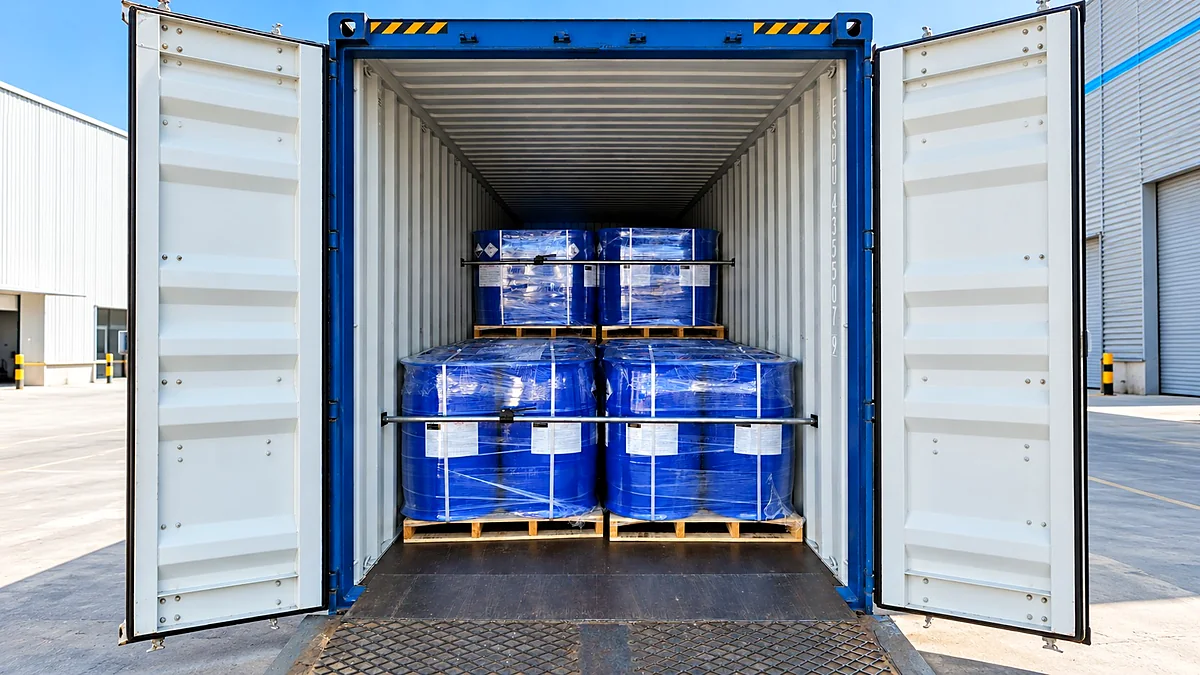
A monomer order is not finished when the container is loaded. What arrives at the destination port, and whether it clears, depends on a set of documents prepared before the vessel sails and on the Incoterm that decides who carries each step. Buyers who know the document set spend less time chasing paperwork and more time running trials.
The core document set
Commercial invoice. States seller, buyer, goods, quantity, unit price, Incoterm and origin. Customs reads this first, and any mismatch with the packing list or the bill of lading becomes a query at destination.
Packing list. The physical description: number of drums, net and gross weight, dimensions, pallet configuration and marks. For hazardous goods the packing list should match the markings on each package exactly.
Bill of lading. Issued by the carrier once the goods are loaded. It is both a receipt and a document of title. Check shipper, consignee, notify party and the description of goods against the invoice before the original is released.
Certificate of analysis. Batch-specific, not a generic datasheet. Most buyers require it before unloading, and some destinations require it for customs clearance of chemicals.
Safety data sheet. In the destination language or in English, in the GHS format the destination accepts. An out-of-date SDS is one of the most common reasons a chemical shipment is held.
Certificate of origin. Required wherever a preferential tariff applies. It must be issued in the form the destination accepts, and it has to be requested early — it cannot be produced retroactively in every jurisdiction.
Insurance certificate. Required under CIF and CIP, and worth having even where the Incoterm does not oblige the seller to arrange it.
What the Incoterm actually changes
The Incoterm does not change the goods. It changes where the seller's obligation ends and the buyer's begins: cost, risk and, in practice, who is on the phone when something goes wrong.
EXW puts almost everything on the buyer, including export clearance. It looks cheap and rarely is, once a buyer without a Chinese entity tries to clear export formally.
FOB is the most common basis for containerised chemical orders. The seller delivers to the named port — Qingdao for most Shandong production — clears export and loads; the buyer arranges the main carriage and import.
CFR and CIF move the main freight into the seller's scope. Under CIF the seller also insures the cargo, at a minimum level defined by the term rather than by the value of your order, which is why some buyers arrange additional cover.
DDP looks attractive on paper and is difficult in practice for regulated chemicals: the seller takes on import clearance and duties in the destination country, which requires an importer of record and local compliance knowledge.
Timing beats price
Most documentation problems are timing problems. The certificate of origin, the SDS revision and any pre-shipment inspection all have lead times that sit outside the production schedule. A shipment sitting on the quay waiting for a corrected SDS is no cheaper than one that started a week earlier.
A short pre-shipment checklist
- Batch numbers on the COA match the drums
- SDS revision is current and in an accepted format
- HS code consistent across invoice, packing list and bill of lading
- Incoterm and named place written identically on every document
- Origin certificate requested before production is complete
- Consignee and notify party match the import licence at destination