What Is 2-HEA and Where Is It Used?
An introduction to the dual acrylic and hydroxyl functionality of 2-HEA and its industrial use in coatings, resins and adhesives.
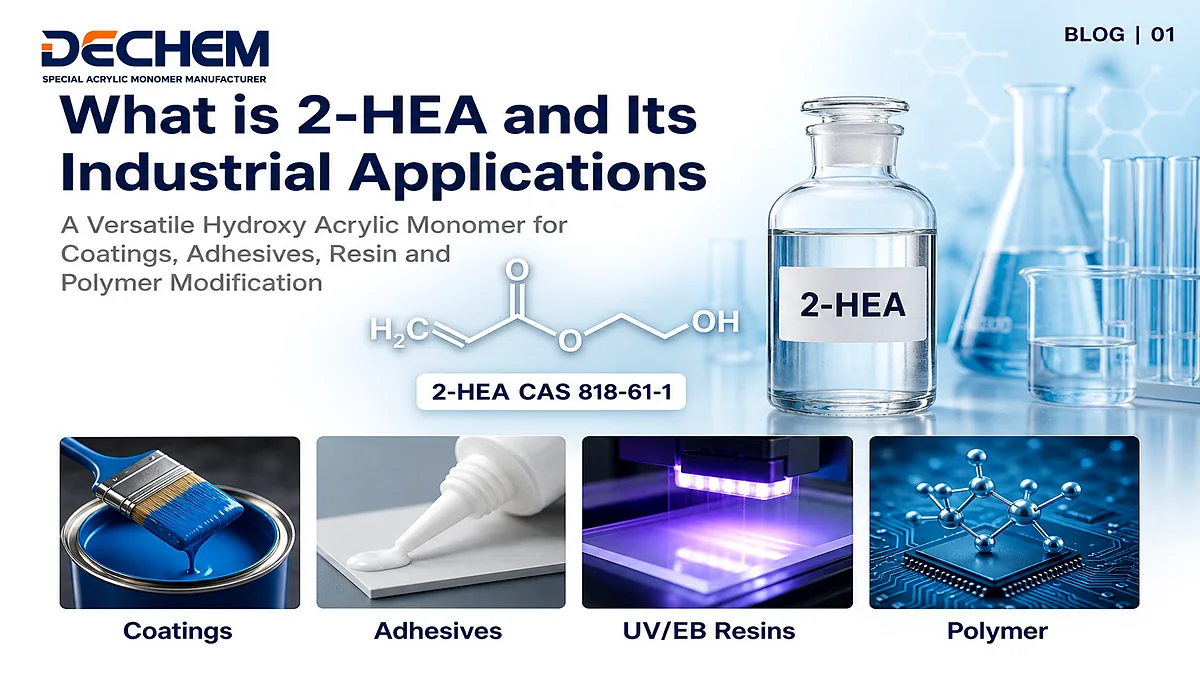
2-Hydroxyethyl Acrylate (2-HEA), CAS 818-61-1, is a hydroxy-functional acrylic monomer. It carries two reactive features in one molecule: an acrylate double bond that participates in radical polymerisation, and a primary hydroxyl group that remains available for crosslinking or further chemical modification.
Why the dual functionality matters
In a coating or adhesive formulation, the acrylate double bond is what enters the polymer network. The hydroxyl group is what allows that network to be crosslinked afterwards — with isocyanates, melamine resins, or other reactive components. Because 2-HEA provides both, it can act as a reactive diluent and as a hydroxyl-functional building block in the same formulation.
Typical industrial use
UV and electron beam curing coatings. 2-HEA is used as a reactive monomer in UV-curable and EB-curing systems. It increases crosslinking density, which improves surface hardness and abrasion resistance, and it provides good adhesion to a range of substrates. Typical uses include UV wood coatings, UV inks, protective coatings and electronic coatings.
Acrylic resins. In hydroxyl acrylic resin manufacture, the hydroxyl group provides reactive sites for further modification. This improves flexibility and adhesion, enhances weather resistance, and raises the overall performance of the polymer system.
Industrial coatings. Automotive coatings, protective coatings and high-performance surface coatings use 2-HEA where a fast-curing reactive monomer with crosslinking capability is required.
Adhesives and sealants. In adhesive formulations, 2-HEA improves bonding strength, flexibility and crosslinking performance.
What a buyer should check
Before placing an order, most buyers want to confirm the same four things: the purity grade they are formulating against, the technical data sheet version that matches that grade, the safety data sheet, and the packaging configuration appropriate for their delivery point. Sample certificates of analysis are also commonly requested to check typical values before a bulk order.
Rather than copying marketing claims, the practical approach is to work from the official TDS for the grade you buy and the COA issued for the specific batch you receive. Those two documents define the specification; everything else on a product page is context.
Handling note
2-HEA is stored in a cool, ventilated area, in tightly closed containers protected from heat and sunlight. Refer to the safety data sheet before handling.