Reading a Monomer COA: Purity, Water, Inhibitor and Colour
What each line on a hydroxy acrylic monomer certificate of analysis actually tells you, and which values are worth challenging before the drum goes into the reactor.

A certificate of analysis tells you what was measured in the batch you actually received. A technical datasheet tells you what the product is designed to meet. The two should agree, but only the COA carries the lot number, the sampling date and the real numbers. For hydroxy-functional acrylic monomers the same handful of parameters appears on almost every certificate, and each one answers a different question about how the material will behave in your process.
Check the identity block first
Before comparing values, confirm the certificate belongs to the material you ordered: product name, CAS number, batch or lot number, manufacturing date, quantity and the specification reference. A COA without a lot number cannot be traced, and a COA whose batch number does not match the drum label is not evidence of anything.
Purity by gas chromatography
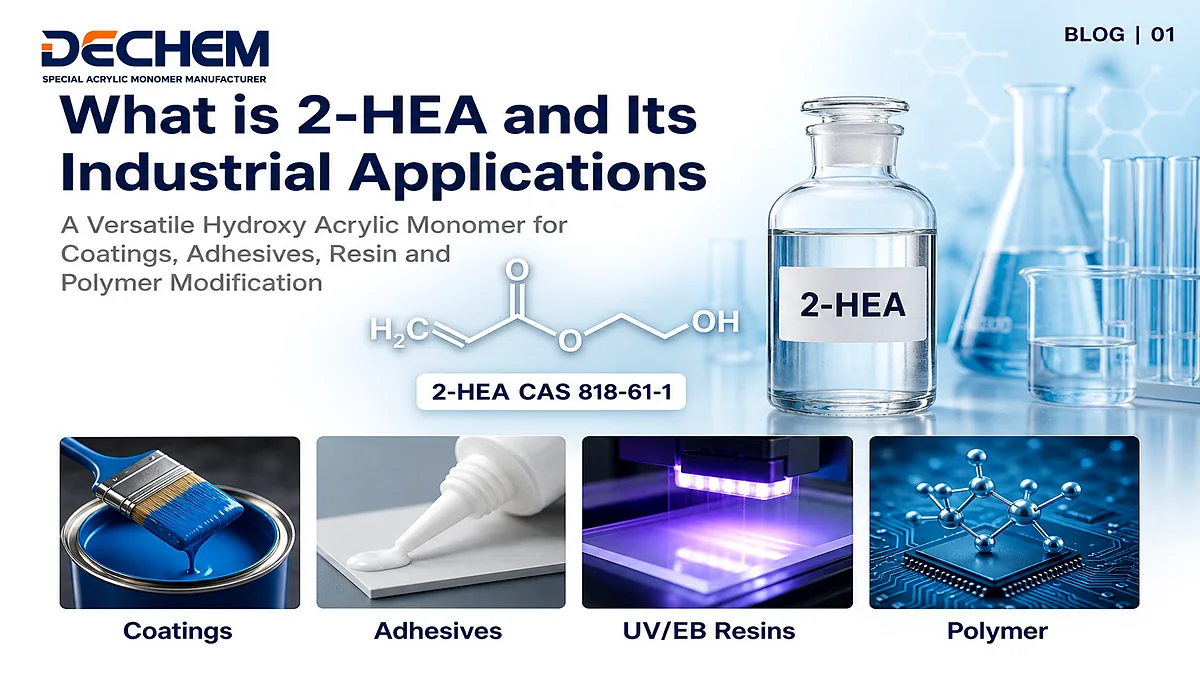
Purity is the headline number. On a monomer such as 2-HEA it is normally reported as a minimum of 97.0% by GC. The figure does not describe how well the product will perform; it describes how much of the batch is the molecule you asked for.
A result close to the lower limit usually points to one of three things: residual starting material, a higher level of a minor isomer, or an analytical artefact from a poorly resolved chromatogram. When a batch arrives at the low end of the range, ask for the chromatogram rather than the summary line. The peak table shows whether the missing percentage is a known, tolerated impurity or something that should not be there at all.
Water content
Water is specified as a maximum, typically 0.10%. It matters for three practical reasons: it consumes isocyanate crosslinker in two-component systems, it can produce haze in a clear film, and inside a carbon steel drum it promotes corrosion at the headspace. A batch reading slightly above the limit after a long sea voyage is usually telling you about the drum's history rather than about the reactor.
Inhibitor content
Acrylic monomers will polymerise on their own if left unprotected, so every drum contains an inhibitor — for 2-HEA, monomethyl ether hydroquinone (MEHQ) in the 200-400 ppm range. The inhibitor only works in the presence of dissolved oxygen, which is why headspace matters as much as the number itself.
Too little inhibitor and the batch becomes a storage risk, particularly in warm climates. Too much and the induction period at the start of your reaction lengthens, or the inhibitor interferes with a thin-film cure. Both directions are worth a conversation before the drum is opened.
Colour
Colour, reported in APHA or Hazen units and typically specified at 30 or below, is a proxy for thermal history and oxidation. A monomer stored hot, or held too long in a warm warehouse, will drift upward. Colour alone rarely changes reactivity, but a jump between consecutive batches is an early warning that something in the supply chain has changed.
Acid value and hydroxyl value
Acid value, usually 1.0 mg KOH/g or below, tracks residual acrylic acid. Elevated values can affect cure behaviour and, in metal-contact applications, corrosion.
Hydroxyl value is the parameter formulators use to calculate crosslinker ratios. For 2-HEA it falls in the 430-500 mg KOH/g range. If you are recalculating an isocyanate index from a COA, use the batch hydroxyl value rather than the datasheet midpoint — the difference is small, but it compounds across a full formulation.
| Parameter | Typical specification (2-HEA) |
|---|---|
| Purity (GC) | 97.0% min |
| Water content | 0.10% max |
| Acid value | 1.0 mg KOH/g max |
| Colour | 30 APHA max |
| Inhibitor (MEHQ) | 200-400 ppm |
| Hydroxyl value | 430-500 mg KOH/g |
What is not on the certificate
Inhibitor, water and colour are routine. Residual solvent, trace metals and the full impurity profile are not, and are reported only on request. If your application is sensitive to any of them — a catalyst that poisons easily, or an end product subject to customer audit — ask at the quotation stage, not after the drums have shipped.
Keep the certificate with the batch
The COA is the only document that ties a specific drum to specific measurements. File it with the batch record, keep it as long as your own traceability procedure requires, and pass it down the chain when your customer asks. When a complaint arrives eighteen months later, the certificate is usually the first thing anyone looks for.